


Golanv Circle
Second Degree
Wednesday Works
Comparative Practices 102
Sigil Craft History
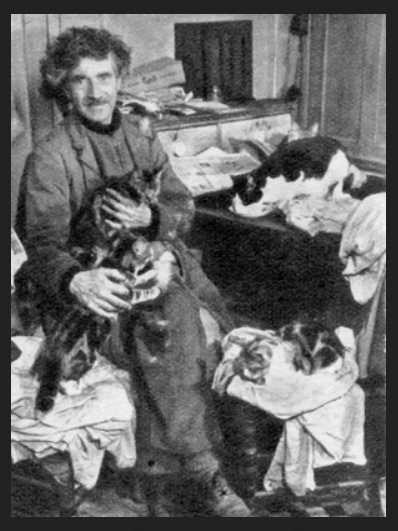
Austin Spare
“Beginning” through the 20th Century
sig·il
/ˈsijəl/
noun
noun: sigil; plural noun: sigils
1. an inscribed or painted symbol that can have magickal power.
o Archaic - a seal.
"the Book of Shadows bore the Witch's sigil"
o Literary - a sign or symbol.
"the appearance of ravens were a sigil that the spell had worked"
Origin: LATE LATIN
sigillum sigil
“sign” late Middle English
We know the use of “symbols”, or “sigils”, has been employed for Medicine, Magick, or other occult purposes since the Neolithic period. The evidence we have is dated to at least 12,ooo years ago. It developed alongside humanity as did other endeavors such as agriculture and hunting. Early sigils were used for things such as : “Good Crops” “Rain” or to have a “Good Hunt”. Prior to that point in human history it becomes hard to trace as “communication” and languages were newly developing from a once nomadic people who communicated magick without words. There are known examples from many cultures around the world. To name a few, we find the yantra from Hindu Tantra, historical Teutonic rune magick and the use of vèvè by the Voudon as being some of the most prolific.
Through the approximate 2.5 million years humans lived prior to written record, there were things such as ‘cave paintings’. Then, about 5,500 years ago, humans began symbolic, “pictoral”, writing. That in turn evolved into the Sumerian cuneiform around 3400 BCE. Although we cannot fully know what was being communicated through that ancient writing, we have a pretty good idea. Those prehistoric and early humans through the Ages, were Earth based people and it shows. There was ritual magick being sigilized right before our eyes.
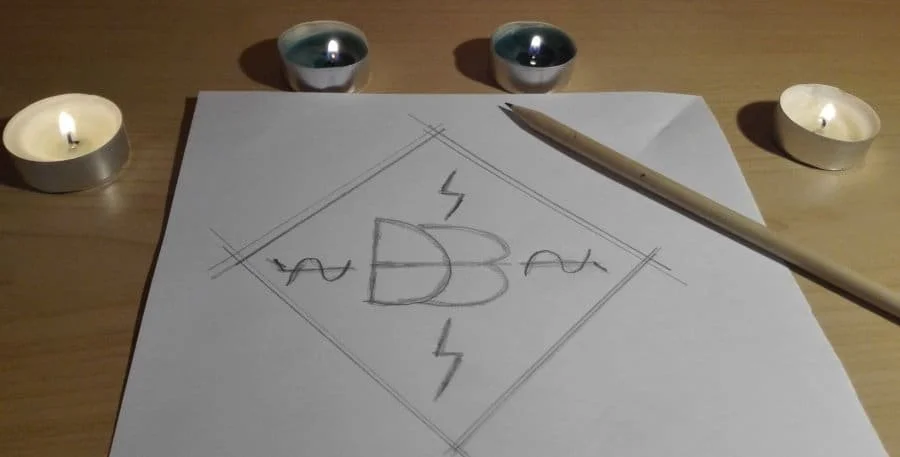
Thousands of years after that, Medieval ceremonial magick was taking place with sigils. Qabalistic mysticism was feverishly paralleling that with its own sigil work which included its squares of mathematical equation. Moving even further in time, to more recent history, we find Practitioners like Austin Spare.
Born December 1886 into a working-class family in London, Spare grew up taking an early interest in art. Gaining a scholarship to study at the Royal College of Art, he trained as a draughtsman, while also taking a personal interest in Theosophy and Occultism. He became briefly involved with Aleister Crowley and his A∴A∴. Developing his own personal occult philosophy, he wrote a series of occult grimoires, namely Earth Inferno (1905), The Book of Pleasure (1913) and The Focus of Life (1921). Alongside a string of personal exhibitions, he also achieved much press attention for being the youngest entrant at the 1904 Royal Academy summer exhibition.
In Austin’s later years, he began to show an increasing interest in witchcraft and witches' esbats, continuing his occult studies and producing artworks with titles such as "Witchery", "Walpurgis Vampire" and "Satiated Succubi". Interested deeply in witchcraft, he was introduced to Gerald Gardner, the “founder” of Gardnerian Wicca, but remained unconvinced that Gardner offered anything of Spiritual merit. He shared this opinion with many Practitioners of the time. Over a period of several years, Spare began work on his third tome, The Book of Pleasure (Self Love): The Psychology of Ecstasy, which he self-published in 1913. Exploring his own mystical ideas regarding the human being and their unconscious mind, it also discussed magick and the use of sigils.
Spare was one of the first Practitioners to elaborate his sigils by condensing letters of the alphabet into diagrammatic glyphs of desire (Will), which were to be integrated into postural (yoga-like) practices—monograms of thought (Intent), for the government of energy. “Zos Kai” was born. Much praise was given to him for this enlightening endeavor by those practicing at the time.
“Hidden in the labyrinth of the Alphabet is my sacred name, the Sigil of all things unknown.”
~ Austin Osman Spare
This level of tantric Magick in logos (word) was very difficult for many to understand but it was there. Why was it so difficult? Many speculate it is/was because of the Church’s influence on society of what was “taboo” and what was not. The manipulation of words proved to have positive results. Some of Spare's techniques, particularly the use of sigils and the creation of that "alphabet of desire" were adopted, adapted and popularized by Peter J. Carroll in the work Liber Null & Psychonaut. Carroll and other writers such as Ray Sherwin are seen as key figures in the emergence of some of Spare's ideas and techniques as a part of the magickal movement.
Prior to his death, Spare was credited with making several distinguishable Magick techniques including those in automatic writing, automatic drawing and sigilization based on his theories of the relationship between the Conscious and Unconscious Self.
Austin Osman Spare died on the 15th afternoon of May 1956, at the age of 69.

Wednesday GD3
General - Journal - Book of Shadows
SUBMISSION: GD3 WED NS
EMAIL
Three Circles Medicine & Magick™
Please utilize the above email link
IF NO BUTTON IS PRESENT
to receive full Submission credit.